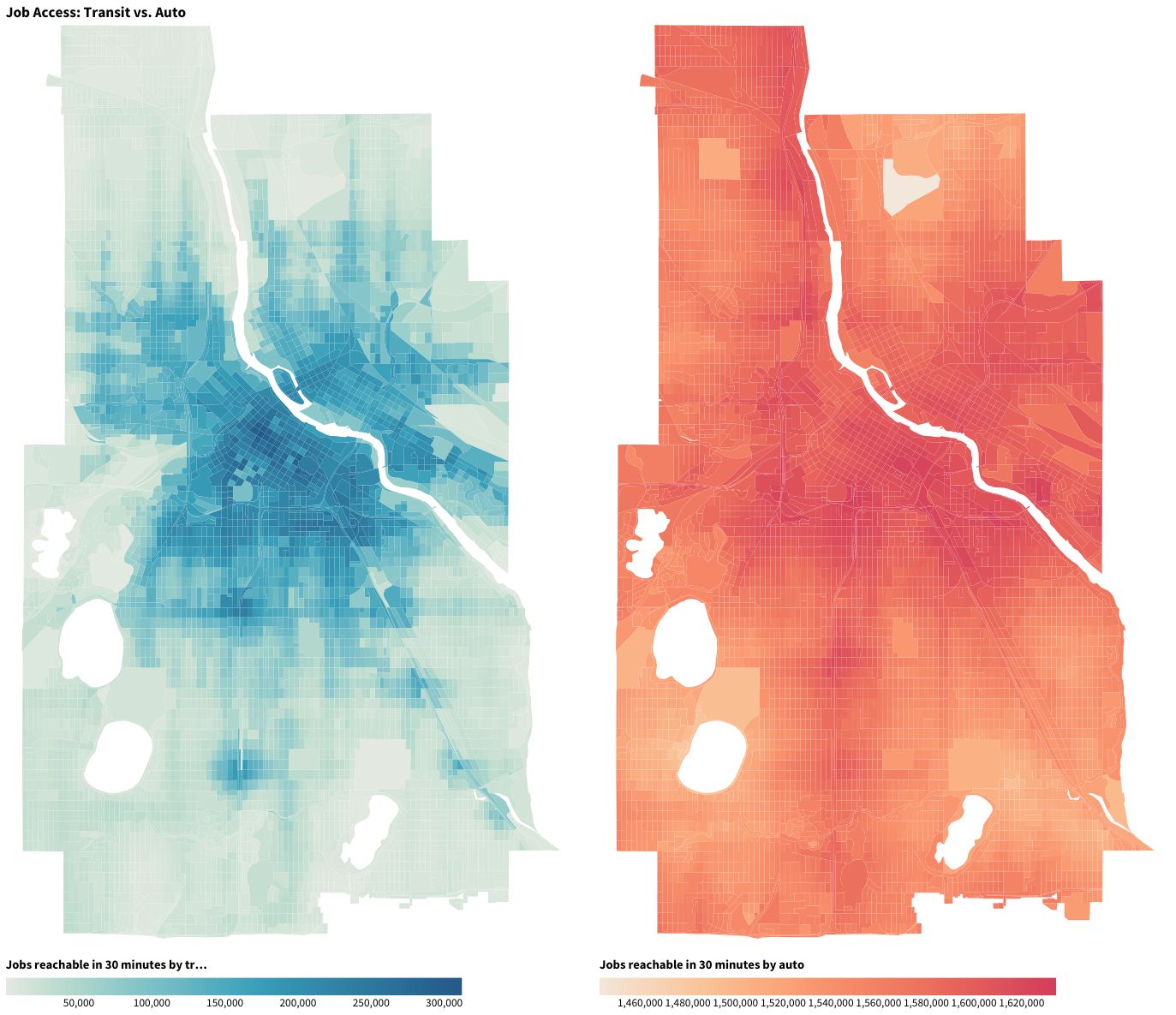
Short-Term Changes in Accessibility
Dramatic land-use change in response to new major infrastructure is rare by definition. In the absence of such major intervention, or in the short-term, how do more regular changes in access come about? Both land use and transportation are constantly evolving, as transportation agencies modify the network and as economic activity fluctuates and is redistributed across a region. How can agencies understand these more gradual fluctuations in access, and use them as performance measures?
Using data from the National Accessibility Evaluation (NAE), it is possible to take a close look at how short-term changes in job access are influenced by changes in both transportation and land use patterns. Between 2022 and 2023, the number of jobs that the average worker in Minneapolis, MN, could reach within 30 minutes by driving increased by +2.1%, from 1,566,769 to 1,599,611. Over that same period the number of jobs reachable within 30 minutes by public transit decreased by −0.4%, from 88,074 to 87,744. These aggregate job access metrics provide a good way to track how the relative usefulness of different travel modes evolves over time; additional analysis can help clarify what is driving the changes in access, which varies by geography.